This material is provided for general informational and educational purposes only. It is not investment advice or a recommendation.
Liquidity is more than trading volume
Liquidity is often described as the ability to trade without moving the price materially. That definition captures market liquidity, but the broader concept also includes funding liquidity: the ability of participants to obtain cash or financing on acceptable terms. The two are closely connected. A market can show substantial reported volume while becoming difficult to trade in size, and an instrument can remain fundamentally sound while financing conditions make it expensive to hold.
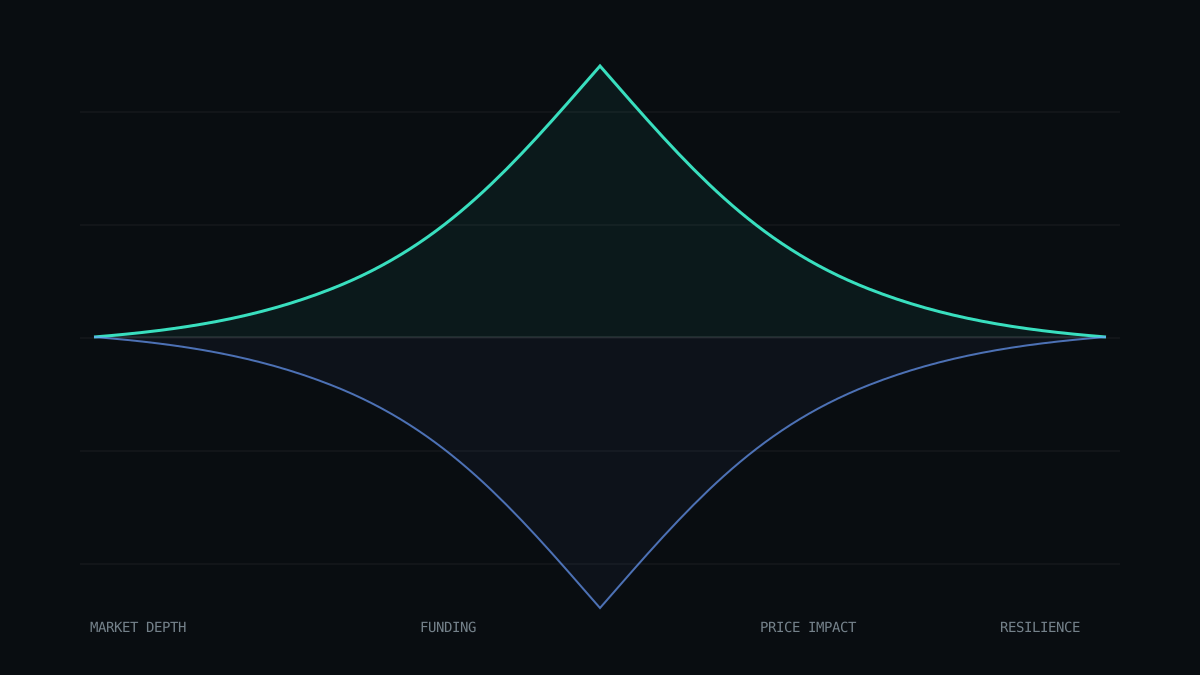
Market liquidity depends on bid-ask spreads, quoted depth, execution size, price impact and the resilience of the order book after a trade. Funding liquidity depends on secured and unsecured borrowing costs, collateral eligibility, haircuts, margin requirements and the willingness of intermediaries to extend balance sheet. No single indicator captures all of these dimensions.
The distinction matters because a trading problem can become a financing problem, and vice versa. Falling market depth may increase the expected cost of liquidating collateral. Lenders can respond with higher haircuts or tighter terms. Those changes may prompt position reductions, creating additional trading pressure and reinforcing the original deterioration.
How liquidity travels across asset classes
Large financial institutions operate across rates, credit, equities, currencies and commodities. Their exposures may be diverse, but they share capital, collateral and risk limits. A funding shock in one part of the system can therefore affect pricing elsewhere. When cash becomes scarce or balance-sheet capacity contracts, participants may reduce positions across several markets at once.
Collateral provides one transmission channel. High-quality securities support financing throughout the financial system. Changes in their availability, volatility or financing terms can influence the amount of leverage that markets can sustain. A rise in margin requirements can create demand for cash even when the underlying economic outlook has not changed.
Currency funding is another channel. Many cross-border assets are financed or hedged in a major funding currency. Changes in short-term funding costs, basis markets or hedging expenses can alter the economics of holding foreign bonds, equities or credit. The adjustments may appear first in foreign exchange but later affect local asset prices and capital flows.
Dealer intermediation connects these channels. Dealers facilitate transactions and temporarily hold inventory, but their capacity is finite. When volatility rises or balance-sheet constraints bind, they may quote smaller sizes or wider spreads. A reduction in intermediation can make ordinary portfolio adjustments more price-sensitive across multiple markets.
What liquidity indicators can reveal
Price-based indicators include bid-ask spreads, financing spreads, deviations between closely related instruments and the price impact of trades. Quantity-based indicators include market depth, turnover, issuance absorption, dealer inventories and the availability of secured funding. Operational signals, such as settlement pressure or persistent order imbalances, can provide additional context.
The most useful information often comes from breadth and persistence rather than a single observation. A wider spread in one security may reflect an isolated technical issue. Simultaneous deterioration across funding, foreign exchange, government bonds and credit is more consistent with a system-wide constraint. A brief disruption around a scheduled event also differs from a sustained loss of market depth.
Relative relationships can be informative. If a cash security and its derivative diverge, financing or balance-sheet conditions may be affecting arbitrage. If highly liquid benchmarks weaken alongside less liquid assets, the move may reflect demand for cash rather than a reassessment limited to one sector. These are diagnostic possibilities, not mechanical rules.
Liquidity signals can also be circular. Rising volatility may reduce risk-taking capacity, worsening liquidity; poorer liquidity can then produce larger price moves and still higher measured volatility. Observing the sequence helps distinguish an initiating shock from the mechanisms that amplify it.
Context matters when liquidity appears to change
Seasonal patterns, market holidays, index rebalancing, tax dates, sovereign issuance and quarter-end balance-sheet reporting can all affect liquidity temporarily. Electronic markets may display ample quoted depth that disappears when prices move. Conversely, wider spreads may coexist with functioning markets if participants can still execute meaningful size and prices recover quickly after trades.
Asset classes also have different conventions. Exchange-traded equities provide visible quotes and transactions, while many bonds trade over the counter and less frequently. Commodity liquidity can concentrate in specific contract maturities. Foreign-exchange activity spans jurisdictions and time zones. Comparing raw indicators without accounting for these structures can be misleading.
Central-bank facilities and public liquidity operations can alter market functioning without eliminating underlying credit or duration risk. An improvement in funding access may stabilize intermediation, but it does not necessarily imply a stronger economic outlook. Liquidity and solvency are related in stress but remain distinct concepts.
A cross-asset framework for interpretation
A coherent liquidity assessment separates funding conditions, trading conditions and the economic reason behind them. It asks whether financing costs are rising, whether transactions are moving prices more than usual, which intermediaries are constrained and whether the pressure is local or broad. It also considers whether policy operations or institutional calendar effects explain the move.
Liquidity is valuable as a cross-asset signal because it describes the market's capacity to absorb risk. It does not provide a standalone forecast or a complete account of fundamental value. Its role is to illuminate how easily positions can be financed, transferred and hedged—and how a disturbance in one market may propagate through the rest of the system.